Culinary Glossary of Terms and Techniques
This glossary defines terms that appear in bold type in this book. It also teaches techniques, and the instructions for each preparation assume you have read the bold-typeface terms in the glossary. For example, rather than saying “cook the onions, carrots, and celery until they become translucent and finish steaming,” the instructions will simply say “sweat the mirepoix.” There is a wealth of information, techniques, and tips in this glossary. You will be a better Chef’s Apprentice for reading it.
A la minute (a la minūte): Cooking or finishing a dish just before serving it.
Acids: Liquids containing acids, such as citrus juice, tomatoes or tomato juice, or wine, are an important ingredient in marinades. The acids break down meat tissues and tenderizes the meat.
Adjust seasoning: Tasting the dish, then adding more salt and pepper if needed, usually just before serving. The presence of salt and pepper should be just apparent.
Aioli: A garlic flavored mayonnaise. In this book, the name “aioli” is used to refer to many mayonnaise-based sauces even if they contain no garlic. Why? Because it sounds better.
Al dente: Literally meaning “to the tooth” in Italian, this is the degree to which most purists believe pasta and risotto should be cooked. It means just ever so slightly chewy, not soft or mushy.
Amuse Bouche: A one or two bite appetizer, usually with intense flavors.
Aromatics: Ingredients that add aroma and flavor to a dish, such as onions, carrots, celery, garlic, and fennel.
Asparagus, Trimming: Trim about 1” to 1 ½” from the end of each asparagus spear. The amount trimmed away is the amount that snaps off easily if you snap the stalk end from one of the spears. After trimming the end, the core of the spear should be greenish, not whitish. If not, trim a little more. Some cooks like to peel the outermost layer from the spears, up to the tip. I don’t believe this is necessary for green asparagus, especially thin green asparagus, but is necessary for white asparagus because they are more fibrous.
Avocado: Avocados are best when ripe. To tell ripeness, they should give a little when pressed or squeezed. To remove the seed, cut the avocado lengthwise and separate into two halves. The seed will remain in one half. Using a chef’s knife, chop the blade into the pit. Using the knife, twist the pit, like the hand on a clock. It will release from the flesh and should be discarded. Use the flesh right away. It will discolor after being cut.
Bake: Cooking food surrounded by dry heat, usually in the oven. Some people say that roasting involves higher temperatures than baking, or that roasting involves added fat and baking does not, but baking and roasting are often used interchangeably. See also Roasting.
Beat: Vigorous mixing or stirring, which incorporates air into a liquid, such as beating eggs, or which incorporates one ingredient into another, such as beating flour into milk to make a roux. Beating can be done with a fork, a spoon, an electric mixer, or an old-fashioned eggbeater. To beat eggs with a fork, move the fork back and forth rapidly in the bowl until the egg yolk and white are completely mixed. The more you beat, the more their volume will increase and the yellow color will become lighter.
Beurre noisette: Clarified butter browned until it begins to smell nutty, like hazelnuts. Brown butter reaches this stage shortly before burning, so be careful. I suggest having a bowl of ice handy so you can sit the sauce pan containing the butter on the ice the moment it reaches this nutty stage. This will stop the cooking and prevent burning.
Blanch: Cooking briefly in salted water at a rolling boil, uncovered. Blanching green vegetables makes them beautifully green and crisp. Blanching bacon removes excess salt. Blanching tomatoes removes their skins (see “Tomatoes, Skinning and Seeding”). I blanch most green vegetables 4-6 minutes, depending on how crisp you like them. If you will be using another cooking method after blanching, blanch them for only 30 seconds to 2 minutes. After blanching, plunge them into an ice bath to stop the cooking. When ready to serve, warm them briefly in the hot water. For best results, use a large pot of water, salted enough so that it tastes like the ocean (I usually use a handful of Kosher salt to about 2 gallons of water). Also known as parboiling.
Bloodline: The dark purplish portion of sushi-grade tuna. Most people find it too strong to eat. Cut it away and discard it
Boiling: Water boils at sea level at 212 F. The boiling point drops as altitude increases. Boiling water is marked by large rolling bubbles. Boiling is different from bringing to a boil, see below.
Bouquet garni: The combination of a bay leaf, sprigs of thyme, black peppercorns, and parsley sprigs or stems, all fresh. Use a piece of kitchen string to enclose them in a small pouch of cheesecloth, so the bouquet can be easily added to stocks, sauces, or soups as they cook, then easily fished out and discarded at the end of the cooking. Some people use a tea ball instead of making a cheesecloth pouch.
Braising: Cooking at a relatively low temperature with added liquid, covered. Meat and vegetables are usually browned before braising. In the oven, braising is usually done at 250 F to 300 F. Slow Cookers are also braisers, as are Dutch ovens. Braising is the best method to cook tougher cuts of meat. Long slow cooking on low heat gradually breaks down tough meat and makes it tender, and develops flavor.
Break: The separation of an emulsified sauce. For example, in making mayonnaise, the sauce is broken if the egg and oil separate.
Breaking down: This usually means to separate or cut a whole animal into its component parts. A chicken, for example, is broken down into two each of the breasts, thighs, legs, and wings. A lobster is broken down into two claws, a body, and a tail. Fish are broken down into filets or steaks. Breaking down can also mean to transform, such as in breaking down a piece of tuna steak into tuna tartare.
To break down poultry, see photographs on p. __.
Brillat Savarin: A butter-like cow’s milk cheese named after a French gourmand known for saying “a day without cheese is like a woman with one eye.”
Bring to boil: Raising the temperature of a liquid until it just begins to boil. Bringing to a boil may be followed by boiling, but in this book it is usually followed by simmering. For example, stocks are brought to a boil, then simmered, but not boiled. Boiling a liquid containing fat, such as a stock in the making, may cause the fat to become suspended in the liquid, preventing you from skimming off all of the fat at a later time.
Broiling: Cooking near an intense heat source, usually under it, such as a flame or an electric or infrared broiling element. Grilling is sometimes used interchangeably with broiling, but in this book grilling refers to cooking over an intense heat source.
Browning: Cooking over medium to high heat, usually in a pan on the stove, or on a grill, to brown the surface of the meat, bones, or other food. The cooking is usually completed in some other way. Browning may simply be the first phase of cooking the food in the pan in which it is browned. Browning can also be done in the oven by roasting with high heat or under a broiler until the surface browns, either at the beginning or the end of the cooking process, even though the bulk of the roasting time will be at a lower temperature. Browning improves both appearance and flavor. When browning, don’t crowd the food in the pan, or it will not brown. See also Searing.
Brule: Deeply browning or caramelizing the surface of a preparation, sometimes after sprinkling sugar on top of the dish, such as some potato dishes and custards. Bruleing is usually done under a broiler, with a kitchen torch, or with a salamander, which is like a branding iron with a round flat plate that is heated, then pressed onto the top of a dish until the surface caramelizes.
Butane Burner: Single or double portable burners powered by butane canisters. These are the burners chefs use at Sunday brunch buffets to make your omelet to order, while you watch. One supplier is Burton (see Equipment List).
Butter: U.S.-made butters are at least 80% fat. The remaining content is liquid and milk solids. Butter is sold salted and unsalted. This book calls for unsalted butter. By using unsalted butter, the cook has better control of the saltiness of the dish.
Butterfly: Slicing a cut of meat almost in two, horizontally, then opening the two pieces like a butterfly. See photos at page __.
Caramelize: Gradually cooking an ingredient until it browns and sweetens, usually on low heat. Some ingredients, such as onions, carrots, and parsnips, contain enough sugar that they will caramelize when cooked in a little stock, without adding sugar. Adding a little sugar helps the process. I usually add brown sugar, turbanado sugar, palm sugar, or mirin when extra sugar is needed or desired. Bruleing is a type of caramelizing. Sugar can also be caramelized for pastry applications.
Caviar: The eggs of certain fish. Expensive caviar comes from certain types of sturgeon. This book uses caviar mainly as a garnish, and it need not be expensive. American paddlefish caviar works well, and has a look, texture, and taste similar to expensive caviar, but costs less. Another type of caviar, Tobiko, or flying fish roe, is often used to garnish some Japanese dishes, such as sushi. Tobiko eggs are tiny and may be flavored, such as Wasabi Tobiko, or colored, such a Red Tobiko.
Celery Root (also known as Celeriac): A flavorful but underappreciated bulbous root vegetable. Cut away and discard the greens, then peel it just before cooking because it will discolor after peeling. To retard discoloration, soak cut pieces in water mixed with a little lemon juice, vinegar, or white wine.
Ceviche: Very fresh fish cooked with acid, not heat. The acid is usually a citrus juice. By marinating the fish in an acid, it becomes firm and opaque. The fish is usually cut into thin slices or cubes so that the acid penetrates through the fish.
Chafing dish: A serving dish in which a pan containing the food is warmed over a pan of simmering water, usually by gel or alcohol fuel, or by electricity.
Charring: Cooking over medium to high heat, usually in a pan on the stove, on a grill, or in an oven, to char the surface of the meat, bones, or other food. Charred foods are cooked past brown, until the food is slightly blackened or burnt. Too much charring will make the food bitter. Just the right amount of charring will give the food a deep, somewhat smoky flavor.
Chevre: Goat cheese. The chevre called for in this book is soft goat cheese.
Chiffonade: Very thin strips of leafy herbs or vegetables, such as basil or lettuce, usually used as a garnish. To make the strips, stack the leaves, then tightly roll them up like a cigar, then thinly slice across the roll.
Chinois (and pusher): A funnel-shaped metal strainer, also known as a Chinese cap. The strainer may have small holes or fine mesh. A Chinois should come with a stubby wooden pestle that tapers like the small end of the strainer. It is used to press ingredients that are being strained, to extract as much flavorful liquid as possible if the liquid is the end product, or to remove as much liquid as possible if the strained ingredients are the end product. A Chinois also sometimes comes with a stand, in which it sits over a catch basin.
Clarification: A processed mixture of mirepoix, chopped lean meat (usually the same type of meat used to make a consommé), egg whites, and a little acid (such as vinegar, tomato, wine, or lemon juice) used to filter impurities from a liquid, such as a stock or consommé. Place the clarification in the bottom of a stock pot, then slowly pour in the liquid. Bring to a boil the liquid, then gently simmer until the liquid is clear, usually about an hour. It sometimes helps to move the pot off center from the heat, to keep the simmer’s bubbles small and the simmer slow and gentle. The clarification will float to the top of the liquid and form a raft. Gently punch a hole in the raft to allow the liquid to bubble through. The raft will look gross and disgusting, but will attract the impurities of the liquid. Carefully ladle out the clear liquid through the hole in the raft, then strain it through a fine strainer or layers of cheesecloth. If you have more time, cool the liquid, then strain it. Discard the clarification.
Clarified Butter: Butter from which the milk solids have been removed. Clarified butter has a higher smoke point than regular butter, which means that it can be cooked at a higher temperature before it burns. To clarify butter, bring it to a boil on medium heat in a small saucepan, watching it carefully. The surface will begin to foam, which is the liquid and milk solids evaporating. You can help it along by skimming off the foam. When the foam disappears and the butter is clear and golden yellow, place the saucepan directly on a bowl of ice, which will stop the cooking. If you boil the butter longer, it will become beurre noisette, then burn.
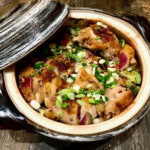
Cocotte: Oval or round cast-iron casseroles, with lids. This book calls for small cocottes. I prefer Staub, oval 3” x 4”, which are a good size for an individually portioned small plate.
Compose: To arrange or assemble a dish in an aesthetically pleasing and usually structured way.
Compound butter or soft cheese: Butter or cheese mixed with finely chopped herbs, shallots, garlic, truffles, seasoning, or other ingredients. Mix the ingredients into the butter or cheese, then roll the butter or cheese into a log about 1” in diameter. Wrap the log in plastic wrap, then foil, and freeze it. When needed, slice off a coin, rewrap the log, and return it to the freezer.
Confit: Slowly cooking in fat. The fat can be animal fat, such as butter or duck fat, or vegetable fat, such as olive oil. Confitted ingredients are lusciously rich.
Consommé: A rich and deeply flavorful broth made from a reduced stock and a clarification.
Coriander root (cilantro): Cilantro and fresh coriander are the same thing. “Cilantro” usually refers to the leaves and “coriander” usually refers to the root. Cilantro is often sold in the U.S. without the root attached. Cilantro with the root can be found in Asian grocery stores, especially Thai groceries, and the root itself is used in some preparations.
Coring: Removing a core, such as the core of an apple or pear.
Cramming the pan: Trying to cook too many portions of food, such as scallops or pieces of beef, in a pan at the same time. This causes the temperature of the pan and the fat to drop, which will prevent searing. The food will steam instead. Portions of food should be well spaced in the pan.
Crème fraiche: Cream that has been slightly fermented and thickened.
Curry Paste, Thai: Prepared Thai curry pastes add a range of unique flavors that cannot be easily duplicated. This book calls for the following types of Thai curry pastes. I recommend buying small cans or jars because a little bit goes a long way.
Green
Massaman
Panang
Red
Dashi: The standard stock of Japan, believed to contain the fifth basic taste, called umami, loosely translated from Japanese as “savory” (the other four tastes are salty, sweet, bitter, and sour). Compared to the stocks of the French repertoire (see “Stocks”), dashi is by far the easiest and quickest to make. Dashi has three ingredients: water, kombu (a type of kelp), and dried shavings (flakes) of the bonito fish, which belongs to the tuna family (see the Ingredients List for sources).
Danger Zone: 40 F to 140 F. In this temperature range, bacteria grow quickly. Food should be kept cooler than 40 F or warmer than 140 F, except for short periods of time.
Deep frying: Cooking food by submerging it in very hot oil, usually around 350 to 375 F. Canola, peanut, and grapeseed oils are usually used for deep frying because they have a high smoke point. Use a candy thermometer to measure the temperature. Be careful. Hot oil is dangerous. It can seriously burn you, and if it gets too hot it can catch fire. When food is added to the oil, the temperature will drop. For this reason, use at least a quart of oil for making the small plates in this book and bring the food to room temperature before deep frying it. Do not try to cook more than 2-3 pieces of food per batch. The more food you add to the oil, the harder it will be to maintain the temperature. If the temperature drops, the food will absorb the oil and become soggy. Properly deep fried food will be crisp and light to medium golden, and will not seem oily. Drain deep fried food on draining racks or on crumpled brown paper. The cooled oil can be kept and reused after straining.
Deglazing: Incorporating into a dish the intensely flavored bits of food and juices (called “fond”) that result from sautéing. To deglaze a sauté pan, remove the food you just sautéed (and keep warm), pour out any excess oil, raise the heat to medium high, and pour into the pan the deglazing liquid called for by the preparation. The liquid is usually wine, Vermouth, stock, or water, but this book may call for deglazing with other liquids, and you can deglaze with any liquid for your own recipes. After adding the liquid, it is usually reduced and the bits of food (fond) are scraped into the liquid. One great side benefit of properly deglazing a pan is that it will need very little cleaning afterward.
Dehydrating: Removing the moisture from foods. I recommend using an electric dehydrator, such as Nesco’s Dehydrator and Jerky Maker (www.nesco.com) and following the manufacturer’s instructions.
Demiglace: The most luxurious and intensely flavorful of the French sauces, sometimes called “liquid gold.” Demiglace is made from veal stock and veal stock is made from veal bones, which yield sufficient gelatin to give this sauce its velvety texture. Historically, demiglace was made by a time-consuming and laborious process, and some purists still believe the old way is best. The modern way to make demiglace still takes time and effort, but less so, and the end result is well worth it. (See the section on making Stocks.)
Demitasse spoon: A small spoon, sometimes called a baby spoon.
Dice: Cutting food into small cubes, usually about ¼” square.
Doneness: The degree to which food is cooked through. Beef, lamb, and duck can be cooked to rare, medium, well, and every gradation in between. Pork can be cooked medium (despite your grandmother’s fears) to well. Chicken is cooked well. These terms roughly correspond to the internal temperature of the meat, shown below. You can measure doneness with an instant read thermometer, but with experience you will be able to judge doneness by feel. See “Slice and Check Method for Doneness.”
Rare: 125 to 135 F
Medium rare: 135 to 140 F
Medium: 140 to 145 F
Medium well: 145 to 160 F
Well: 160 to 180 F
For fish:
Rare: 115 to 120 F
Medium rare: 120 to 125 F
Medium: 125 to 140 F
Medium well 140 to 145 F
Well: 145 F and up
Pasta and Risotto:
al dente
Double boiler: A covered pot with an upper chamber and a lower chamber, used for indirectly and gently heating food. The lower chamber is partially filled with water, heated to a boil, then simmered, and the food to be heated is placed in the upper chamber. A double boiler can be improvised by placing a pot or bowl over another pot containing boiling or simmering water.
Dredging: Lightly coating food before cooking, usually in flour or bread crumbs, or both. This is often a three-step process. The food is first dredged in flour, then dipped in an egg wash, then dredged in bread crumbs. Three flat-bottomed pans about 6” to 8” x 8” to 10” are best for this purpose, but plates can also be used.
Duck Fat: Fat rendered from a duck. Sautéing food in duck fat adds depth and flavor and duck fat has a fairly high smoke point.
Duck, Rendering Fat: You can render your own duck fat by slowly cooking down duck skin, allowing the fat to cool, and refrigerating it in a covered container, the same way you would store bacon fat. The remaining skin, called cracklings, make great dog treats.
Dust: Sprinkling or very lightly coating. For example, lime zest may be dusted over a finished dish to add just a hint of citrus zing. In preparing ramekins to make a soufflé, you must dust the buttered ramekin with flour, sugar, or finely grated cheese. To do so, fill one buttered ramekin about one quarter full with the dusting ingredient. Holding the outside of the ramekin at an angle, rotate the ramekin so that the ingredient rolls around the sides and sticks to it. When completely coated, pour any extra into the next ramekin and repeat the process until all ramekins are dusted. DON’T TOUCH THE RIMS OR INSIDES OF THE RAMEKINS, OR THE SOUFFLÉ WILL STICK TO THE RIM WHEN IT RISES.
Dutch oven: A cast iron pot with a tight-fitting lid, used for braising.
Eggs: Eggs are an extremely important ingredient. They can stand on their own in a savory dish, or they may be an ingredient of a sauce or custard. Chicken eggs are the most common, but this book also calls for duck eggs, which are a bit larger, and quail eggs, which are much smaller, with beautiful dappled brown and white shells. Working with eggs requires knowing many techniques. The special techniques of this book are the following:
Separating: Sometimes you need only whites and sometimes you need only yolks. Most preparations that call for one or the other will not be ruined if some yolk strays into the white, or vice versa. An exception is whipped egg whites. They will not whip if even a hint of yolk is present. To separate an egg, lightly crack it on a flat surface. Then, holding it vertically, gently break away the top half of the shell, leaving the egg in the bottom. Carefully pour off the white into the other half of the shell, dropping the white into a small catch bowl. Pour the yolk back and forth, from shell to shell, trying not to break it, until all of the white has fallen into the catch bowl. Assuming there is no yolk in the bowl, pour the white into another bowl. Pour the yolk into a third bowl. Repeat the process with the next egg. This three-bowl process assures that no yolk creeps into the white. Egg separating devices are sold, but learning to separate an egg is a basic skill that any Chef’s Apprentice should learn by trial and error.
Setting: Many preparations call for the eggs to set, or to become firm. This could mean the yolk or the white, or both. Whites set at about 145 F and yolks set at about 155 F.
Topping: The removal of the top of the egg shell. I know of three tools for this purpose, the scissors type, the plunger type, and a third type that reminds me of a medieval torture device I once saw in a museum in Venice (if you have been there, you know the one). I prefer the plunger type. Eggs have a broader end and a narrower end. Using the device of choice, carefully remove the top of the egg, which is the narrower end. If the preparation calls for using the shell, pour out the egg and keep it for another use, and rinse the shell. If you think eggs are delicate, topped eggs are even more so, so handle them very gently. I usually top two more eggs than a preparation calls for, in case one or two break.
Whipping: Bring the eggs (in their shells) to room temperature. Separate the whites, as described above. Be sure there is no yolk in the whites. Whites will not whip if even a hint of yolk is present. Place them in a mixing bowl and beat on high until stiff peaks form. Egg whites are usually whipped to form stiff peaks.
Egg wash: Lightly beaten eggs, with a pinch of salt, used for dredging or brushing on the surface of food.
Emulsion/Emulsify: Mixing liquids that do not normally mix, such as oil and water or egg yolks and oil. To form an emulsion, vigorously whisk the oil into the other ingredient in a very thin stream, either by hand or in a food processor. Add the oil or yolk no faster than you are able to incorporate it into the other ingredient. The oil will become suspended in the water or yolk to form a velvety mixture.
Fat: In this book, “fat” means butter, any kind of oil, such as olive or canola, and any kind of animal fat. It can also mean the milk fat in cream. Hot fat is used to cook foods. The more hot fat you use, the more the food can absorb.
Fat Separator: A measuring cup with a spout that pours from the bottom of the cup. Pour a liquid containing fat into the cup and let it settle. The fat will rise to the top. Pour the liquid from the spout, then discard the fat or keep it for another use.
Finishing: Performing the final steps of a preparation, before serving. This is similar to garnishing and may include garnishing. Finishing steps include sprinkling with salt, grinding with pepper, squeezing with lemon, dusting with zest or parsley, or assembling ingredients on the plate, depending on the preparation.
Finishing in the Oven: Completing the cooking of an ingredient in the oven. The cooking may have begun in a pan or on a grill, where medium to intense heat was used to sear the meat. The meat is them placed in the hot oven to complete the cooking process.
Fish sauce: A salty Asian liquid condiment made from fermented fish. Used sparingly, it adds depth and zing to sauces.
Flaming: Igniting a high-alcohol liquid — such as cognac or Armagnac — after it is added to a pan, to burn off the alcohol, leaving and intensifying the flavor of the liquid. Do not pour the alcohol directly from the bottle into the pan. One technique for flaming is to place a thumb over the opening of a liquor bottle, sealing it closed, then invert the bottle over the pan. Then release the thumb just enough that the desired amount of liquor flows into the pan. Move the bottle to a safe distance and cap it. Then tilt the pan until the flame under the pan comes into contact with alcohol at the rim of the pan, igniting the alcohol. BE CAREFUL. The alcohol usually ignites in a big flash. The flash of fire could be bigger than you expect, so stand back and keep your face and clothing away from the pan. An alternative to the bottle and thumb method is to pour only as much liquor into a small dish or glass as you want to add to the pan. Move the bottle to a safe distance and cap it, then pour the liquor into the pan. Rather than lighting the alcohol by tilting the pan into the flame, you can use a match or lighter. After lighting, do not stir the liquid or the flame will extinguish before the alcohol is burned off. The alcohol will burn off pretty quickly. Leave it alone and let it do so. If for some reason you want to put out the flame before it burns out, the flame can usually by quickly quenched simply by swirling the liquid in the pan. If you are afraid to flame a dish, don’t do it. An alternative is to add the liquor to the pan, then cook it on medium heat for a few minutes, to evaporate the alcohol.
Flan: A baked custard, which may be savory or sweet.
Flavorate: One of my word inventions, meaning to allow flavors to mix, meld, and deepen. Marinating flavorates and tenderizes meats. Mixing a dipping sauce in advance allows the ingredients to flavorate together.
Fleur de sel: A very special sea salt from France. Literally, “flower of the sea,” it is made from evaporated sea water, and therefore is flaky. The taste is briny but delicate. This salt is great for finishing a dish.
Flanken Cut: A butcher’s cut for beef short ribs in which the cut is made through the bone, not along the bone. I prefer flanken cut ribs about ½” thick for the preparations in this book.
Flattop: A smooth, flat griddle, which may be built into a stove or may be an accessory that sits on top of gas burners. It provides a large, very hot flat surface for searing and grilling.
Foie gras: Goose or duck liver. Foie gras is usually either seared in a very hot pan, poached in a flavored liquid that contains alcohol, or made into a pate. The main vein must be carefully removed from a lobe of foie gras.
A reliable searing method is as follows:
Slice lobe into 1” thick slabs, lightly season with kosher salt and a peppermill, then sear the slabs in a very hot nonstick pan, 20 seconds per side. Finish in the over at 300 F for 7-8 minutes on a sizzle plate. Deglaze the nonstick pan with aged balsamic vinegar or Chambord. Swirl in 1 tsp. demiglace. Drizzle the foie gras with the deglazing liquid and serve warm.
Sous vide also works well for foie gras. Seal a piece of foie gras, about 6” (long) x 4” (wide) x 1 ½ to 2” (thick) in a vacuum bag, then cook in the water oven at 140 F for 1 to 1 ½ hours. Remove from bag and sear in a medium hot cast iron pan about 30-45 seconds per side, which should golden-brown it nicely.
Fold/folding: Gently turning a batter, meringue, or sauce over onto itself with a tool, such as a wooden spoon or rubber spatula, to incorporate another ingredient. Folding is used when the mixture is intended to be airy. The goal is to minimize the amount that the mixture is worked with the tool. For example, you may fold egg whites that have been whipped to soft peaks into a soufflé batter. The egg whites contain a lot of air that has been whipped into them. The air helps to maintain the volume of the soufflé and gives it its light and airy texture. You want to keep that airiness. To fold in the whipped whites, drop them into the batter. Then, using the tool, dig deep into the batter, lift it up, and gently fold it over onto the whites while moving the tool around the inside surface of the bowl. Repeat this folding action as few times as possible to incorporate the whites.
Fond: Another word for stock. Also, the browned bits of food left in a pan after cooking. The bits can be deglazed and incorporated into a sauce.
Forcemeat: A seasoned ground meat mixture, which is sometimes forced through a sieve. The mixture is often used as a filling.
Frenching: Scraping the meat away from the end of a bone. This is done for aesthetic reasons. Lamb chops are often frenched. Frenching also means to cut vegetables or legumes into thin strips, hence the name “French fries.”
From on high: When garnishing a dish with a chopped herb, such as parsley or mint, sprinkle it from your pinched fingers, about 18” above the dish. It will fall like snowflakes and dust the dish nicely.
Galangal: A root with a ginger-like flavor that is grated, ground, or powdered, and used as a spice.
Garnish: Noun: A garnish is a finishing touch for a dish, such as a chopped herb (parsley, cilantro, mint, sage, basil), citrus zest, or an important ingredient. For example, a dish could be garnished with chopped ham or sautéed mushrooms. Verb: To decorate a dish with finishing touches, or to do the final assembly of a dish. When garnishing with chopped herbs, I like to sprinkle from a height of about 12” – 18” (see “From on high”). This causes the herbs to fall evenly around the plates, with a nice distribution.
Glaze: A sweet or savory shiny coating for a dish or ingredient, usually made from super reducing a sauce to a couple of tablespoons.
Gnocchi: Small, pillow-like dumplings made from flour or potato-based dough.
Grapeseed oil: The oil of grape seeds. It has a relatively high smoke point.
Grilling: Cooking directly over a heat source, such as charcoal, wood, or gas burners, such as a barbeque grill. In this book, “grilling” is used more loosely to mean cooking either on a grate or on a solid surface, such as a griddle. If you have no outdoor grill, a good alternative is to use a cast iron grill pan, such as the Lodge Logic Grill Pan, which will leave grill marks in the meat.
Heat diffuser: A plate or disk, usually made of metal (which may be perforated), that can be placed between the bottom of a pot and a stove burner, to reduce the amount of heat being applied to the bottom of the pot. A heat diffuser is often used when the lowest heat setting of the burner just isn’t low enough.
Herbs de Provence: A mixture of dried herbs that may include bay, basil, fennel seed, lavender, marjoram, rosemary, sage, savory, tarragon, and thyme.
Ice Bath: A bath of ice cubes and water into which blanched foods, usually vegetables, are plunged to stop the cooking and set the color of the food. Use a generous sized ice bath, enough to stop the food from cooking instantly.
Infused: Flavoring one ingredient, usually by soaking or gently heating another ingredient in it. For example, olive oil may be infused with garlic or herbs by soaking the garlic or herbs in oil that is room temperature or warmed on the stove. Also, cooking beans in stock infuses the beans with the flavor of the stock. A cup of tea is tea-infused water.
Insaporire: The Italian concept of building or layering flavors. A good way to do this is to use the same pan to cook a later ingredient or preparation, without washing, that you used to cook an earlier ingredient or preparation for the same meal. For example, use the same sauté pan in which you seared scallops for one dish to sear the beef in a later dish. Note that this is contrary to traditional practice of using a clean pan to cook each separate protein. The traditional technique is used to prevent the protein from sticking to the pan. My method of using the same pan works best works if sticking is not an issue after the first use of the pan.
You can also use some of the same fat from a prior step to cook something in a later step. For example, after cooking bacon or sautéing sausage for one step, use the fat from the pan to cook an ingredient in a later step. Whenever I have a nicely oiled pan or some fat left over from an earlier step or dish, I think “how can I use this for insaporire?”
Juicing: Extracting the liquid from fruit or vegetables.
Julienne: Food sliced into matchstick-sized pieces.
Kecap Manis: An Indonesian seasoned version of soy sauce, but darker, thicker, and sweeter.
Keeping warm: Recipes often tell you to keep something warm, but rarely tell you how to do it. This can be an art in itself. Here are some techniques. If your stove has a stainless steel shelf above the burners, do what I do: simmer a stockpot about 2/3 full of water on a back burner, under the shelf. It will keep the shelf warm, and can be used for blanching. The shelf is a great place to keep food warm, or to rest meats, for a short time. Another technique is to heat an oven to 150 F and warm the food inside the oven. To avoid drying out your food in the oven while keeping it warm, either cover the ovenproof food container with foil, a lid, or another container, or place a baking pan about half full of water on the bottom shelf of the oven. To keep small quantities of food warm, cover a simmering stockpot with a splatterguard that is wider in diameter than the stockpot. You can then place small plates, bowls, or containers on top of the splashguard. The heat and steam from the stockpot will keep the food warm. You can also keep food warm in a double boiler or a chafing dish. You may also be able to keep food warm on the lowest stove burner setting, but this may cause the food to become overcooked. I sometimes use a heat diffuser between the pot and the burner, with the burner set on the lowest setting, to keep food warm without further cooking it. When keeping food warm, please be aware of the Danger Zone. Keeping food warm generally means no cooler than 150 F.
Kneading: Vigorously massaging bread dough or meat.
Lassi: A chilled Indian drink made from yogurt, herbs, spices, and sometimes sugar.
Lemongrass: A stalky herb used in Thai and Vietnamese cooking. The white root is used for cooking, and is often bruised or lightly crushed before using, to help release its flavors.
Maki: a sushi roll.
Mandoline: A very sharp-bladed device used for making thin slices of uniform thickness, usually from vegetables. The French version is made of metal, is fairly expensive, has legs that allow it to stand on its own, and can make fairly thick cuts. The Chinese version is made of plastic, costs little, has no legs, and makes only thinner cuts. Although I own both, I find myself using the Chinese mandoline more often. Be careful. It is easy to cut yourself when sliding the last nubs of food over the blade, and therefore it is safer to slice down only to the last ¾” or so of the food (no less than you can safely hold without losing your grip on it). Some people use a slider that presses the food to the cutting surface and protects the hand. Others use a protective glove.
Marbled: The visible fat in a piece of meat, usually beef or pork. The more fat, the greater the marbling, the more flavor in a cut of meat. In wagyu or matsusaka beef from Japan, the best cuts, from the ribeye, are beautifully marbled, so that the ratio of red meat to white fat is about one to one, if not favoring fat over meat. Some restaurants incorrectly call wagyu beef “kobe.” Kobe beef comes only from Kobe, Japan.
Marinate/Marinade: Soaking food in a flavored, acidic liquid, to tenderize it and add flavor. The acid may be wine, liquor, citrus, vinegar, etc.
Meat: In this book, “meat” can mean any type of protein, such as red meat, poultry, or seafood.
Melting onions: Cooking onions long and slow on low heat, with a little fat, such as oil or butter. The onions will become golden and very soft and translucent, almost as if they melted.
Mignonette sauce: A mixture of red wine (1/2 cup), chopped shallot (2 Tb.), and coarsely ground black peppercorns (1 Tb.), and Kosher salt to taste. This sauce is often served with raw oysters on the half-shell.
Mincing: Chopping food so finely that it seems like it has been ground.
Mirepoix (meer pwah): The traditional base of many preparations in French cooking, such as stocks, soups, and sauces, comprised of chopped onions (3 parts), carrots (2 parts), and celery (1 part). In this book, “mirepoix” usually means these three ingredients, but the proportions may differ. “Mirepoix” may also refer more loosely to a soup or sauce base comprised of one or more of these three ingredients, sometimes with additions or substitutions, such as shallots, leeks, or garlic.
Mise en place (mees en plaas): Having all of the ingredients you will need prepped and ready before cooking begins, and close at hand.
Mirin: A sweet and flavorful Japanese, rice-based, alcoholic cooking beverage that is both fermented and brewed. It is a cousin of sake.
Miso: Salty Japanese fermented soy-bean based pastes. There are many varieties of miso, named for their color (red, white, yellow, brown), ingredients (rice, barley), or style (moromi, blend).
Molecular Gastronomy: A progressive food preparation movement that uses chemistry to obtain unique flavors, textures, and other results. No MG techniques are used in this book.
Mounting: Whisking small pieces of cold butter into a sauce a la minute. In this book, “mount” also means adding the finishing touch to a dish, such as mounding sautéed mushrooms in the center of a bowl of soup just before it is served.
Mousse: A custard-like preparation made rich and airy by incorporating whipped egg whites or cream, or gelatin. In this book, the mousses also use forcemeats, which means here that ground meat, such as lobster, is forced through a sieve, then mixed with eggs, cream, or gelatin.
Napping: Lightly coating food with a sauce, usually with a brush or the bottom of a spoon.
Needling: Partially piercing meat with a device resembling a small bed of nails. The piercing helps to tenderize the meat, which is often then marinated. The piercings allow the marinade to seep into the meat, further tenderizing and flavorating it.
Nori: Thin sheets of dried seaweed, often used to wrap sushi rolls (known as “maki”). It can be bought toasted or untoasted. Untoasted nori should be toasted before it is used, which tenderizes it and deepens the flavor. To toast nori, place the sheet in a hot, dry pan. Watch it carefully and turn it as it toasts. When it turns from dark purplish green to deep medium green, it is done. Nori can also be toasted by holding it with tongs over a low open flame on the stove.
On the bias (see “Slicing on the Bias”)
Pan fry: Frying in fat, in a frying pan, using medium to high heat. Meats should be very dry before frying. If they are damp or wet, them will steam in the pan and will not brown. Don’t use any more oil than is necessary. The more oil you use, the more the food can absorb.
Panko Bread Crumbs: Coarse, crisp Japanese bread crumbs.
Pan Roasting: Cooking in fat in a covered frying pan. The food is normally seared in the hot, uncovered pan, then the cooking is finished in the covered pan on medium heat. The cover makes the pan like a small oven, trapping heat and moisture.
Persillade: A mixture of chopped parsley and garlic, used as a flavoring, coating, or garnish. Seasoning and other herbs of your choice can be added to a persillade, along with bread crumbs. To make an effective persillade coating, add enough olive oil to make a paste with the consistency of applesauce. A persillade coating may be used as an insulating layer, to protect meats during roasting with high heat.
Piment d’ Espelette: Dried flakes of the French Espelette chili pepper. It has a mild spiciness.
Piping:
“Piping” can mean a measure of heat, as in “serve piping hot,” which means very hot (steaming hot) but not boiling.
“Piping” can also mean a pastry bag, also known as a piping bag. Food squeezed from a pastry bag is “piped” onto the plate.
Plate, Plating, or Plate Up: Arranging the food on the plate, just before serving it.
Poach: Gently cooking in a simmering flavored liquid, or plain water, for a relatively short time.
Pooling: Making a puddle of sauce on the plate or in shallow bowl. If the sauce is thick enough to stay together in the puddle, the pool is usually small, a tablespoon or two. If the sauce or broth is thin, more may be used, like a little pool in which the main ingredient swims.
Portioning: Cutting meats into the size appropriate for the dish. Main course sized portions of meat and fish should be about 6-8 oz. Small plate sized portions should be about 2-4 oz.
Pounding: Beating an ingredient firmly and repetitively, usually with a hammer-like tool, to flatten and thin an ingredient. For example, chicken breasts or pieces of beef may be sandwiched between two layers of plastic wrap, then pounded with a meat pounder to a uniform thickness. If pounding several pieces at once, space them sufficiently because each piece will spread as it thins and flattens.
Preparation: Instead of using the word “recipe,” which focuses more on an end result than the process of getting there and does not really acknowledge the techniques you will learn here, this book uses the word “preparation.”
Prepping: Short for preparation or preparing ingredients.
Presentation Side: This means whichever side of a piece of meat you plan to be facing up and presented to the guest. Sometimes this is the skin side if the skin is attractive. Often it is not. If the skin has been removed, the other side is the presentation side.
Process: In this book, “process” means to run the food through a food processor. Never run the motor of the food processor any longer than is necessary to obtain the desired result. Usually, very little processing is required and pressing the “pulse” button for a few short bursts usually gets the job done.
Protein: Chef-speak for the meat component in a traditional meal, specifically, meat, poultry, or seafood. In cooking lingo, a meal is traditionally comprised of three parts, the protein, such as red meat, the “veg” (pronounced “vej”) or vegetable, and the starch, such as potatoes, bread, or rice.
Puree: Liquefying an ingredient or preparation, usually in a blender or food processor. Pureed foods usually have a thickness anywhere from a paste to a little thinner than applesauce. They are usually not as thin as water. When pureeing foods, it is better to start thick. It is always easy to add a little more liquid to thin out the puree. But it is harder to thicken a puree that is too thin.
Quail Eggs: Quail eggs are about one quarter the size of chicken eggs. They are beautifully dappled in white and brown. Quail eggs become hard boiled after bringing to a boil, then steeping in the hot water, off the heat, for 3-5 minutes.
Raft: A clarification that has floated to the top of a consommé.
Red Sea Salt: Reddish or pink salt, usually Himalayan or Hawaiian.
Reduce/reduction/reduce to perfection: “Reduce” means to cook a flavored liquid, usually on medium to high heat, until its volume diminishes through evaporation. A “reduction” is a liquid, such as a stock or sauce, that has been reduced substantially from its original volume. The more the liquid reduces, the more its flavors are concentrated. This applies to salt too. As a salty liquid reduces, the reduction will become saltier. As a flavored liquid reduces, it usually becomes thicker and in many cases takes on a pleasing color and sheen, such as a glaze. Many preparations in this book say to “reduce until almost dry,” or something similar. The goal in such cases is to evaporate almost all of the liquid, until the remaining ingredients are just wet, but not dry or burned.
“Reduce to perfection” means to reduce the sauce or glaze gently, over medium to low heat, until it looks and tastes just right. The sauce/glaze should be thick enough to coat the bottom of a spoon, with a slight sheen, and the taste should be deep and balanced.
Refreshing: Some foods that are not fresh can benefit from being refreshed before they are used in a preparation. Different foods may be refreshed in different ways. Use the following methods to refresh ingredients used in this book.
Saffron: Heat a pinch of saffron in a little water. Remove the saffron from the water after it swells, then chop it. Add the chopped saffron and the water to the preparation. Refreshing the saffron in this way releases more color, especially in cold sauces.
Shellfish (scallops and shrimp): Toss the scallops or shrimp (peeled or unpeeled) in a generous amount of Kosher salt or sea salt. Use a lot of salt. Gently rub the shrimp with the salt. Then thoroughly wash away the salt. Refreshing the shellfish in this way helps to restore the taste of the sea. (See also “Shrimp, Refreshing”)
Truffle slices (jarred or canned): There is no substitute for fresh truffles, but they are very expensive and obtaining really fresh ones is difficult in the U.S. For sources of near-fresh truffles, see the Ingredients List. The best approximation of fresh truffle aroma and taste is truffle oil or truffle butter. But sometimes a preparation calls for not just that taste and aroma, but the look too, usually as a garnish. This calls for preserved whole or sliced truffles. Unfortunately, they lack that magic taste and aroma of fresh truffles. I have tried several methods for refreshing preserved truffles. The best approximation of fresh truffles, albeit a very loose approximation, is to toss sliced preserved truffles in newly opened black or white (preferably white) truffle oil, then let them soak in the oil in a small airtight container for about 10-15 minutes. Garnish the preparation with the slices and drizzle with the oil. The reality is that almost all of the flavor and aroma comes from the oil; the slices provide the visual element.
Residual Cooking: See “Resting.”
Resting: Conventional wisdom in Western cookery says that meats should be allowed to sit in a warm spot, away from the cooking heat source, lightly covered, for a short period of time before serving. This is called allowing the meat to rest. The meat will continue to cook while it rests. This is called “residual cooking.” Resting allows the pressure inside the meat, which increases during cooking, to normalize. If the meat is sliced before the pressure normalizes, the juices will run out. Also, poultry will slice better, rather than falling apart, if it rests before slicing. The “Slice and Check Method for Doneness” is an entirely different approach. Pasta dough can also be rested. If you overwork pasta dough while making it, it can become rubbery and tough. Allowing the dough to rest under a damp cloth will help it to relax.
Ricer: A device that looks kind of like a giant garlic press. Food, such as boiled potatoes, are placed into the hopper. The press is then closed on the hopper. As your hand squeezes together the presser handle and the hopper handle, the potatoes are forced out of the multiple small holes in the hopper. The extruded potatoes can then be mixed with warm milk or cream to make creamy, lumpless mashed potatoes.
Ring Mold: Metal rings of various diameters and heights, used to cut or form food into round discs or round stacks.
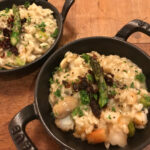
Risotto: A luxurious rice-based preparation hailing from Italy. Certain short-grain rice such as Arborio, Baldo, Carnaroli, or Vialone Nano are used, which yield a very rich result. Hot or warm stock is gradually added to the cooking rice (the stock should be hot or at least warm; if not, it will retard the cooking of the rice each time it is added, which may result in overworked rice). Because the rice is very absorbent, it becomes infused with a lot of flavor. Risotto tastes very creamy, even if cream has not been added, and is usually flavored with other ingredients like peas, lobster, asparagus, fennel, shrimp, chicken, or mushrooms, and may be finished with freshly grated cheese and/or butter. I believe risotto is too rich to be a main course, unless a small portion is served. Dinner guests rarely finish large portions of risotto, partly because it is so rich and partly because it becomes boring to eat your way through a big bowl of it. Also, doggy bag risotto is rarely eaten, which makes large portions a waste. Thus, in this book risotto is a small plate or a small-portion accompaniment to some other preparation. See “Risotto Master Recipe.”
Roasting: Cooking food surrounded by dry heat, usually in an oven. See also “Baking” and “Pan Roasting.” Purists make a distinction between baking and roasting, arguing that in the latter the food is uncovered, fat may be used, and the temperature may be higher. But there is no official temperature range for one or the other and roasting sometimes involves covering, as in tenting a roasting turkey with aluminum foil, or pan roasting. Fat can also be used in both, as fat is an ingredient of baked cakes and greased baking pans. So, in this book, roasting and baking mean essentially the same thing.
Roasting chestnuts: Heat oven to 350 F. Find the flat side of each chestnut and score it with an X, using a sharp paring knife. Place the nuts scored side up on a baking sheet and roast about 30-45 minutes, until the shells peel back around the scoring. Cool the nuts to the touch, then peel by hand.
Roasting peppers: Roast peppers directly on the open stove flame until charred black all over. Then place peppers in a brown paper bag and allow them to steam for about 20-30 minutes. Remove from bag and peel away and discard blackened skin. Remove seeds and stems. Alternatively, slice peppers in half, break off stem and root, shake out seeds, rub with olive oil, and roast in the oven at 350 F cut side down on an oiled baking sheet until the skin is charred black, about 20-30 minutes. Peel away and discard the skin. Remove seeds and stems.
Rotisserie oven (with basket): A home kitchen device for roasting food on a spit exposed to a heat source. I recommend the Ronco model, promoted with the well-known slogan “set it, and forget it,” which is what I call my rotisserie oven. This device lets you come pretty close at home to professionally cooked rotisserie foods. The Ronco models come with both a rotating spit (for whole foods, such as chickens) and a metal basket that fits onto the spit and holds pieces (like chicken pieces). The roasting times in this book are for the Ronco models. www.ronco.com .
Roulade: Meat, such as beef or chicken, that has been sliced or pounded thin, then rolled with a savory filling. The roll is usually secured with string, skewers, or toothpicks, or sometimes wrapped in foil, then roasted. If it is not foil-wrapped, it is usually browned, then roasted or braised.
Roux: A cooked mixture of roughly equal parts flour and fat (melted butter or oil), which gives body and flavor to sauces and other preparations. To make a roux, whisk the flour into the fat and cook over low to medium heat. You must always watch and stir a roux so that it does not burn, especially on the bottom, and you must be especially vigilant the higher the heat. A white roux, which is usually made with butter, is cooked only long enough to cook the flour and remove the floury taste. A blond roux is also usually made with butter and is cooked until golden. A brown roux is cooked until light brown and may incorporate beef fat or other fats. In Creole cookery, the roux is cooked until it is the color of peanut butter, or even darker, and is used as the base for gumbo, jambalaya, etouffee, and other dishes.
Rub: A mixture of dried and ground spices, herbs, salt, pepper, and sometimes sugar that is rubbed into meat before cooking, to give flavor that intensifies as the meat cooks.
Sake: A Japanese rice-based alcoholic beverage. Sake is sometimes called rice wine, but this is not quite right. Wines are fermented grapes. Sake is both fermented and brewed, using rice, yeast, and a special mold called koji. The most common grades of sake are junmai, ginjo, and daiginjo, which equate to the amount of the rice grain that remains after polishing: junmai, 70% to 100% remaining, ginjo, up to 60% remaining, and daiginjo, 30% to 50% remaining.
Sake lees: The fermented rice sediment from sake-making. It makes an effective and flavorful marinade. Also known as kazu in Japanese. See the Ingredients List for a source.
Salamander: The broiler in a professional kitchen. At one time, several companies made stoves for home kitchens with a small salamander. At this time, I know of no companies that make them for the home. “Salamander” also means a tool comprised of a cast iron disk welded to the end of a metal rod. The disk is heated until it is very hot, then used to brown the presentation surface of food, or to brule the top of certain preparations, such as crème brule.
Salt: In this book, salt is always Kosher salt, unless otherwise specified. It is harder to oversalt with kosher salt than with table, or iodized salt.
Saltimbocca: A classic Italian preparation of thinly sliced or pounded veal topped with paper-thin ham, such as prosciutto, and sautéed and/or braised in white wine and butter. In the U.S., saltimbocca is often prepared as a roulade and the filling often includes asparagus and cheese, such as mozzarella or gruyere. As you can see from this description, which mixes Italian, French, and U.S. preparations, terms, and ingredients, Saltimbocca has moved beyond its roots. In this book, it means a preparation in the style of the classic.
Sansho pepper: Not really a pepper, and not really very spicy, the aromatic seed pods of the Japanese prickly ash tree are ground and used as a seasoning in Japanese cuisine.
Sauté: Frying quickly on the stove on medium to high heat with a little fat. Sautéing is usually done with thin or small to medium pieces of meat, or other small pieces of food, which do not need to be cooked very long before they are done, or where they will be finished in the oven. Meats should be very dry before sautéing. If they are damp or wet, them will steam in the pan and will not brown. To prevent sticking, leave the cooking food alone until it releases itself from the pan, or releases with only a little, gentle prodding. Don’t use any more oil than is necessary. The more oil you use, the more the food can absorb. Compare with Searing.
Savory: The opposite of sweet. Cooking and food can be divided into two great categories, savory and sweet. Sweet food is easy to define and understand: it contains sugar or another sweetener. Savory food can contain sweeteners, but the focus of the food is on the other ingredients and flavors. Also, savory is the meal. Sweet is the dessert.
Scalding: Bringing to a boil milk or cream, either alone or containing other ingredients. For example, onions may be scalded in cream by bringing to a boil onions in the cream.
Scallops: Small scallops are called bay scallops. Large scallops are called sea scallops. The preparations in this book use sea scallops, specifically, “dry” sea scallops. Scallops are sold “dry” or “wet”. Wet scallops have been treated with a chemical additive, which helps them stay moist and last longer before cooking. Because of their artificially high moisture content, wet scallops are hard to sear and brown. The goal in searing a scallop is a beautiful brown crust. To get this crust, use dry scallops and medium high heat.
Scoring: Making shallow cuts in meats or vegetables. The cuts are usually parallel (such as when cooking duck breast, see “Duck Breast Master Recipe”), or in a cross (for roasting chestnuts or cooking brussels sprouts), or in a decorative pattern.
Sea Urchin: The porcupine of the sea. Sea urchin roe is a great Japanese delicacy, and is called uni in Japanese.
Searing: Cooking for a short time on high heat, to brown the surface and seal in the flavors. The cooking is then completed in some other way, at a lower temperature, such as Pan Roasting, Roasting, Sous Vide, or Grilling. Searing is usually done with thicker pieces of meat or other thick foods. Thus, the searing does not cook the food until it is done. Compare to browning and sautéing.
Seasoning: In this book, “seasoning” or “season” mean add salt (Kosher salt) and freshly ground pepper or ground white pepper. See also “Adjust Seasoning.”
Shabu Shabu: A Japanese dish in which very thin and highly marbled slices of beef are dipped briefly into simmering water at the table. The beef cooks immediately and is eaten after being dipped in sauces. After all of the beef has been eaten, vegetables are added to the water, which the cooking beef has turned into a broth. The vegetables are then eaten, followed by the broth. In Japan, the cooking is done for you in the best restaurants, usually by a traditionally dressed woman kneeling at the head of your tatami table (table without legs). “Shabu shabu” supposedly describes the sound of the beef sliding into the simmering water.
Shao Xing: Chinese sweet cooking wine.
Shirring eggs: Baking eggs in individual cups, dishes, or their shells. The eggs are usually covered with milk, cream, bread crumbs, cheese, or some other topping. The eggs are usually cooked until the yolk is soft, like a soft-boiled egg. Also called Eggs en Cocotte.
Shishito peppers: A small, sweet, green Japanese pepper with not too much spice.
Shocking: Plunging blanched foods into an ice bath, which stops the cooking and sets the color.
Shrimp, Refreshing: Almost all shrimp sold in America are frozen, which robs them of some of their fresh flavor. This is a technique for making shrimp taste more like they are fresh from the sea. After peeling and deveining the shrimp, place them in a strainer. Generously douse them with sea salt or Kosher salt. Use a lot of salt. Gently rub the shrimp with the salt. Then thoroughly wash off the salt in cold water. See also “Refreshing, Shellfish.”
Shucking: Opening oysters and removing them from their shells. To shuck an oyster if you are right-handed, hold it firmly in your gloved left hand with the hinged end toward your fingers and the other end toward the base of your palm (use a heavy work glove). Using an oyster knife, press the blunt tip of the knife into the slightly flat point where the top and bottom shells come together. Dig the knife steadily into the flat point, between the top and bottom shells, until the shells release. Slide the knife around the membrane of the oyster to release it from the bottom shell.
Sift: To pass an ingredient, usually flour, through a sieve, which removes impurities, incorporates air, and helps you to incorporate the ingredient into other ingredients gradually and evenly.
Silverskin: The silvery membrane on red meats. It should be trimmed away before cooking the meat.
Simmer: Cooking a liquid at a low temperature, so that tiny bubbles roll to the surface.
Sizzle Plate: Metal plates used in professional kitchens. They are usually oval and about half the size of a dinner plate. They are good for cooking foods under a broiler, finishing in the oven, resting, prep, and many other uses. See the Equipment List for a source.
Skimming: Removing a substance from the surface of a liquid. For example, skimming fat from the top of a soup, stock, sauce, or other preparation, skimming the scum that forms on the top of a stock while it cooks, or skimming the foaming milk solids from the top of clarifying butter.
Skinning Fish: To skin a fish filet, hold the knife still and parallel with the cutting board or table (but with a very slight downward angle to the blade), between flesh and skin, and firmly pull the skin into the knife while gently but firmly sawing the knife forward. Keep pulling and sawing until the knife has cut the skin away from the filet. If properly done, little or no meat of the fish should be attached to the skin after you have removed it.
Slice and Check Method for Doneness: This foolproof method of cooking beef or other meat to the desired doneness is unconventional in the West but common in Japan, especially in teppanyaki restaurants. It works well when you are cooking several uniform-sized small-plate portions of meat at the same time, especially when the meat will be sliced for plating.
The method: When the meat is cooking and you think it may be close to the desired degree of doneness, slice one of the pieces of meat in half, or wherever you will make the first slice for plating. If not done to the desired doneness, resume cooking, placing the cut faces of the meat as close as possible, face to face. After a little more cooking time (depending on the thickness of the meat and the desired degree of doneness), slice another piece (or slice the first piece again, if it is fairly large). If not done, repeat the process with the next piece (or the same piece), until done the way you want it. When the meat is done to the desired doneness, slice each remaining piece, plate up, and serve immediately.
Western cooks may say this method will result in losing juices each time the meat is cut, and that it skips the benefits of resting. I have seen it done many times in Japan and have tasted the result, which is always very juicy and flavorful. Any loss of juices is less noticeable if you are working with highly marbled meats. There is also a way to have your cake and eat it too, which also works well if you do not plan to slice the meat for plating: cook one or two more pieces of meat than you plan to serve. Do all of the slicing and checking on the extra pieces, remove all of the pieces a few minutes before the test pieces reach the desired degree of doneness, and rest them for a few minutes before slicing and plating the uncut pieces. Eat the test pieces for lunch the next day.
Slicing on the bias: Slicing meats diagonally across the direction in which their natural grain runs.
Smoke point: The temperature at which fats smoke, which is just before they burn or catch fire. Butter and olive oil have the lowest smoke points (although the smoke point of clarified butter is somewhat higher than for regular butter). The oils with the highest smoke points are canola, peanut, and grapeseed, and therefore they are best for high temperature cooking, such as deep frying.
Smoker/Smoking: Smoking is a method of preserving food. In this book, smoking is used to cook and flavor food. Stovetop or grilltop smokers are available for home use. For a makeshift smoker, place about 1 cup of small pieces of hardwood, such as cherry or hickory, in the bottom of an old wok (don’t plan to use the wok for anything but smoking after you smoke in it once). Cover the wok and place it on a hot outdoor grill. Cook the wood until it starts to smoke. Place the food to be smoked on a sizzle plate and place the sizzle plate on top of the wood chips. Cover the wok and smoke the food until it reaches the desired degree of doneness. You can use the Slice and Check Method for Doneness.
Sous vide: Cooking in vacuum-sealed plastic bags at a constant temperature. The cooking temperature is the temperature of the desired degree of doneness. For example, beef is cooked to medium doneness at 140 – 145 F. By placing vacuum-sealed beef in a water oven set to 143 F, the beef will cook to that temperature, no more, no less. And just as braising tenderizes tough cuts, so does sous vide because the food is cooked at a low temperature for a long time. The cooking time is the amount of time needed to bring the entire piece of meat to the desired temperature, and to tenderize it. Compared to braising, which is slow, sous vide cooking is very slow. Depending on the toughness and thickness of the meat, anywhere from 1 to 48 hours (or more) may be needed to cook and tenderize the meat. The vacuum seal is also important. Bacteria grows rapidly in foods between about 40 and 140 F (the so-called “Danger Zone”). Cooking beef, for example, to rare means cooking it to 130 -135 F, which is in the Danger Zone. Bacteria could grow rapidly at that temperature for that much time, but not in a vacuum.
Spiking: Adding alcohol to a preparation.
Splatterguard: A disc of wire mesh that can be placed over a frying pan or pot to prevent the contents of the pan or pot from splattering.
Starch: Chef-speak for the starch component in a traditional meal, such as potatoes, rice, bread, or corn. American meals are heavy on starch. The other two components are the protein and the veg.
Steaming: Cooking over steam. Steamers may be purpose-made, or makeshift. In either case, water simmers or boils in the bottom of the steamer while food cooks above it in a basket or on a rack. The steamer is covered to keep in the steam and the flavors and juices of the food.
Steeping: Soaking in a hot liquid, usually off the heat.
Stocks: Salt-less broths of meats or vegetables. Stocks are the basis of many preparations, such as soups and sauces, and are used in many others. Most meat stocks are made essentially the same way: sweat a mirepoix, add meat bones (browned or not), cover the bones and mirepoix with water, add a bouquet garni and garlic, bring to a boil the stock, simmer for a long time, skimming occasionally, then strain the liquid and discard the rest. See the “Stock Chart” for the details of making various types of stocks. Also see “Roasted Duck Stock” at p. __.
Sweating: Cooking mirepoix, vegetables, garlic, or other ingredients in a little fat on low heat until the water they contain is sweated out as steam and the ingredients become soft or translucent. The ingredients should not be browned. To assure consistent cooking and avoid browning or burning, heat the mirepoix in cold fat and watch it closely, especially garlic, which will burn quickly. Garlic is often added after the fat is hot. Techniques to avoid burning the garlic are to (1) stir the mirepoix and watch it closely after the garlic is added, (2) lower the heat when the garlic is added, or (3) remove the pan from the heat, add the garlic, and sweat the garlic in the warm pan while stirring. Sweating is the first step in many preparations, especially in French and French-inspired cooking, such as creative American cooking.
Swirling: Incorporating an ingredient into a soup, sauce, or glaze by gently stirring it in a circular or spiral motion. The goal is to mix in the ingredient (and sometimes to melt it), without adding air (as in whisking). For example, a piece of butter may be swirled into a sauce (see also Mounting), a small lump of foie gras may be swirled into a glaze, and sherry or balsamic vinegar may be swirled into a soup, as finishing touches.
Tartare: Chopped raw meat, usually beef or tuna, to which seasoning and other ingredients are added, such as herbs, spices, and onions.
Temper: Adding a hot ingredient to a cold one, or vice versa, in such a way that the temperatures partially equalize. For example, if a hot liquid is added too quickly to eggs it can scramble or curdle them. To temper hot cream into beaten eggs, pour a little of the cream down the inside surface of the mixing bowl and whisk it into the eggs. As the liquid runs down the bowl, it cools somewhat as it is exposed to air. The whisking adds more cooling air and helps raise the temperature of the eggs at the same time it is cooling the cream. After tempering in this first amount of cream, whisk in the remaining cream. This technique can be used to temper other ingredients.
Tempura: Japanese deep-fried battered food. Tempura batter is different from batters used for deep drying in the West. To make tempura batter, mix with a pair of chopsticks 1 cup of flour, 1 cup of ice water (preferably club soda), one egg yolk, and a healthy pinch of salt. The chopsticks will mix the ingredients, but not well, yielding a lumpy batter. Foods, such as shrimp, scallops, and vegetables, are then lightly dipped in the lumpy batter and deep fried until lightly golden. The lumps and club soda make a light and airy batter with air pockets. The cooked food is dipped into a sauce and eaten.
Thai Curry Paste (see Curry Paste, Thai)
Thickeners: Thickeners such as corn starch, flour, and arrowroot are used to thicken liquids and sauces.
Toasting: Browning dry foods or ingredients without fat, using dry heat. For example, bread may be toasted in a toaster or oven, bread crumbs may be toasted in an oven or a dry pan, pine nuts and sesame seeds may be toasted in a dry pan, and nori may be toasted in a dry pan or over an open flame.
Tomatoes, Skinning and Seeding: To skin tomatoes, score the skin in an X on the bottom of each tomato. Then plunge the tomatoes into boiling water for 30 seconds. Then plunge the tomatoes into an ice bath to halt the cooking, for about 1 minute. The skin should then peel away easily. If not, repeat the process, but leave the tomatoes in the boiling water only for about 20 seconds so that they do not cook.
To seed tomatoes, cut them vertically into 4 to 8 wedges, depending on the size of the tomato. Using a teaspoon, spoon away the seeds. The remaining tomato meat can then be sliced or diced. A quicker but more wasteful way of seeding is simply to pare away all of the tomato pulp and seeds, leaving only the outer shell of the tomato pieces. I use this method if the pulp is hard, yellow, or mealy, but otherwise I use the first method because it wastes less. An even quicker way it to squeeze each tomato in your hand. Most of the seeds and much of the liquid will ooze out and can be discarded. Use this method if it does not matter how the tomatoes will look after you remove the seeds. Do this in the sink or a deep bowl so that the seeds and liquid don’t spray all over you and your kitchen.
Torch: A butane torch made for kitchen use. A kitchen torch is used to brown, brule, or caramelize preparations, usually just before they are served.
Truffle: A fungus that is thought to be one of the world’s great delicacies. They are rare, hard to find, and expensive. Although good truffles are flavorful, the quality they add to most preparations is aroma. In my opinion, white truffles are the best, but black truffles from certain parts of France and Italy are highly prized. Truffles are available in processed products, such as preserved whole truffles, truffle juice, canned or jarred truffle shavings, truffle paste, and truffle-scented olive oils. All of them are poor substitutions for fresh truffles, but truffle paste and truffle oil are probably the closest approximations. See also “Refreshing, Truffles.”
Umami: Western cooks speak of four primal flavors that register on the taste buds: sweet, salty, bitter, and sour. The Japanese believe there is a fifth primal flavor, which they call “umami.” There is no direct translation for “umami,” but some people say it means, roughly, “savory.”
Umeboshi Plum: A very tart variety of Japanese plum. They are available dried, salted, and pickled, and are used to flavor vinegar and sake.
Veg (pronounced “vej”): Chef-speak for the vegetable component in a traditional meal. The other two components are the protein and the starch.
Vermouth: An aperitif derived from white wine, available sweet or dry. Dry vermouth is a good substitute for white wine in almost any preparation. I use it when I don’t want to open a bottle of white wine, or none is handy. I learned this trick from Julia Child. At the time of her TV show, many Americans had Vermouth in their liquor cabinet (for their martinis), but good white wine was rare. Thus, rather than telling viewers to use white wine, she recommended dry Vermouth.
Wasabi: A root in the horseradish family, which is freshly grated and served in Japan with sushi and sashimi. Fresh wasabi root is expensive and hard to find outside of Japan. In the U.S., most wasabi is a paste made from mixing wasabi powder with water in the ratio of 1:1. However, wasabi powder usually is not wasabi at all. Rather, it is usually a mixture of horseradish, mustard, and green food coloring. The powder-to-paste version is a poor substitute for fresh, which is less harsh and more subtly flavorful than the paste. Wasabi is sometimes available outside Japan in tubes. The contents of the tube may be real grated wasabi root, or powder-to-paste, or both. The more expensive it is, the more likely it is real grated wasabi root.
Water bath: A container of water in which foods or preparations sit while cooking. For example, custards are often baked in ramekins that sit in a baking pan containing water that reaches about half way up the sides of the ramekins. The surrounding water causes a gentle and constant heat transfer.
Water Oven: A device that heats and holds water at a constant temperature, below the boiling point. Foods are slowly cooked in the water, usually in a vacuum-sealed pouch. In this book, a water oven is used for sous vide cooking.
Whipping cream: Heavy cream, with a milk-fat content of 30-40%, depending on whether it is light whipping cream or heavy whipping cream. These creams may contain other ingredients, such as emulsifiers that help the cream to whip. To whip cream, for best results use cold cream in a cold bowl with a cold whip.
Whisking: Mixing ingredients with a wire whisk. Whisking mixes ingredients while incorporating air into the mixture. To mix or blend ingredients, hold the whisk in your full palm and make deliberate turns at slow to medium speed. To incorporate air, hold the top of the whisk handle as you would hold a pencil and whisk rapidly.
Wilting: Cooking leafy vegetables until they lose their natural structure. In this book, wilting means to cook them until they just lose their natural structure. For example, wilting spinach takes less than a minute. After washing spinach leaves and spinning them dry, they still hold some water on the leaves. Briefly sauté them in olive oil, Kosher salt, and a grind or two of pepper, and some chopped garlic, tossing them constantly. For a large quantity of leaves, partially cover them for a few seconds, which speeds the wilting. They are properly wilted when they start to lose their leaf structure but still maintain the color of the leaves. I strive for wilted leaves that have not cooked so long that they totally lose their leaf structure and become darker in color.
Yuzu: A Japanese citrus fruit that is kind of a cross between lemon, lime, and orange, which is prized mostly for its zest. Also known as Japanese Citron.
Zest/Zesting: The outmost layer of citrus fruit, it is the part that makes a lemon yellow, a lime green, and an orange orange. It contains aroma, flavor, and color, and is used as an ingredient or a garnish. It is easily removed with a special tool called a zester, but I prefer using a microplane grater. Be careful to use only the outmost color layer. The whitish pith underneath is bitter.